The problem
In asymmetric remote collaboration, a remote helper guides an on-site worker through a video link. They never share a viewpoint, so neither can point with their eyes the way two people at the same table do without thinking.
A mouse cursor is the usual substitute, and it is a poor one. The helper's hands are often already busy, and a cursor only moves once you have decided to point. Your eyes were there a second earlier.
Why a webcam
A lab eye-tracker is precise and still rare. A webcam is on every laptop and misses by a few degrees. Eye tracking will spread, but unevenly, so collaborators will keep arriving with devices that do not match. CoGaze estimates gaze from a consumer webcam on one side, and asks which kinds of shared attention survive that mismatch.
What we compared
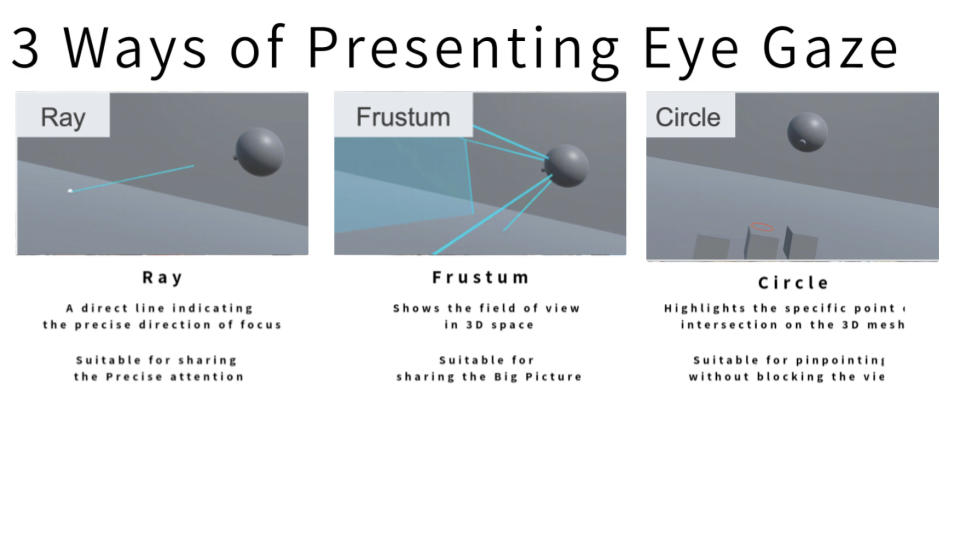
The study compared three ways of drawing someone else's gaze on screen: a ray, a frustum and a circle.
What is next
CoGaze was a small version of a larger question: can one person hand their attention to another without replacing what the other person sees? Shared gaze was already known to work in MR when both people wear the same headset. CoGaze looked at a pairing that does not match. The open question is how attention should be shown when the two sides sense and see differently, whatever the hardware becomes.